

Portable Solar technology transitioning Local Farmers to clean energy in Kenya’s Embu County
 By Polite Musa
In Mbeere South, Embu County Eastern Kenya, many locals had previously failed to utilize their resources fully due to the lack of access to water from old seasonal rivers that run through the region until Linda Kamau and her friends under their brand name Sow Precise Africa started the pay as you irrigate Portable Mobile Solar Services (The sun rider)
Despite Mbeere being arable and highly productive, farmers struggled to access affordable irrigation and for those who treat farming as a business, most depended on conventional irrigation systems such as fuel-powered pumps or diesel and petrol generators which are costly to purchase and maintain on top of unpredictable and soaring price of fuel.
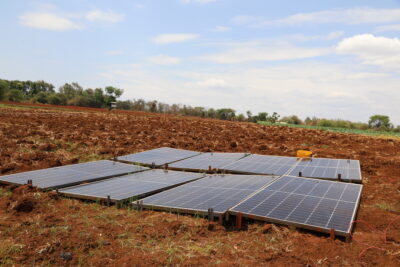
In many maize, vegetables, kart, sweet potatoes gardens in most areas along river Thibu, Morning sunlight is harnessed as an asset. Solar panels glint under the bright skies, powering the very systems that turn this challenging environment into productive farmland
How it works
Pius Musyoka, chief operations manager at Sow Precise Africa narrates that the process begins at a river or another water source where the water is drawn from. Solar panels are installed near the river to convert sunlight into electricity. A solar-powered water pump designed to lift water from the river to a higher elevation or directly to the irrigation system is connected to the solar panels and From the intake, pipes carry the water to the pump.
When the sun shines, the solar panels generate electricity, powering the pump which draws water from the river and pushes it through the piping system, distributing to the irrigated land. And the uniqueness with the sun rider, farmers pay USD 200= for every one hectare of land irrigated.
Affordable and sustainable irrigation solutions
Linda Kamau, chief executive officer at Sow Precise Africa is revolutionizing agriculture with her mobile solar irrigation service. Recognizing the challenges farmers face with unreliable rainfall and expensive diesel pumps, Linda founded Sow Precise Africa to provide affordable and sustainable irrigation solutions.
Her company offers mobile solar-powered irrigation systems that farmers can hire, eliminating the need for costly equipment purchases and maintenance. This innovative approach is increasing crop yields, saving farmers money on fuel, and giving them more time for other income-generating activities, contributing to food security and economic empowerment in the region
Why the sun rider?
Linda says over 20 million people in Kenya live in Arid and semi-Arid lands and because of limited or no rains, most of them struggle to find water to irrigate their crops, hence contributing to less that 20% of the national food output.
“Less than 1% of the Arid and Semi-Arid land is under irrigation despite 70% of farmers living within a 3 kilometer radius vicinity of rivers. This needed such an innovation like the sun rider to turn things the other way round” Linda added
She believes last mile solar powered local irrigation could enable high production and close the gap of spending over USD 2billion on food imports annually and unlock year round farming in Kenya’s Arid and Semi- Arid lands.
This was made possible because 3200Km of permanent rivers flow across the Arid and Semi-Arid areas and 50 million hectares of Kenya’s semi-Arid and Arid have potential for irrigation. This could also supplement on government of Kenya’s approved budget of USD 600 million to build 25 new dams and rehabilitate over 4000 water pans to expand irrigation.
Founded in 2023, the Sun rider has proved effective to the farmers by giving the irrigation services at an affordable cost. In 2023, the technology was tested with potential customers and validated, in 2024 it was iterated based on user feedback and by then, 200 farmers were on the waitlist and 15 active farmers were served. in the same year, Linda secured her first ever pre-seed capital funding of USD 200,000= while in 2025 they entered the market, serving over 150 farmers with a 98% retention rate and over 500 farmers are on the waitlist.
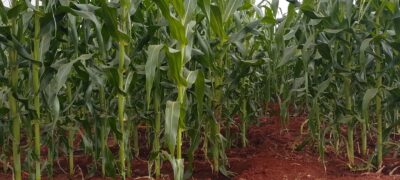
One of the maize gardens irrigated by the sun ridder
Carried directly to the garden
Sun RIDER, a solar – powered movable irrigation system is designed specifically for low income farmers, providing them with affordable access to water throughout the year.
It is ownership free unlike the most common way of buying all solar equipment and incurring operational costs, Linda and her people carry the solar systems directly to the gardens, using an electric-powered cart locally known as (Mkokoteni), irrigate the gardens and farmers pay USD 200 per acre.
It’s also mobile and can reach anywhere in the garden and can be adjusted accordingly on top of being eco-friendly because it is 40% cheaper than diesel alternatives.
In order to encourage more women into farming as business and the need to be gender sensitive, most women who don’t have cash are allowed to pay after making sales, roughly after four months of the season. Linda says she has not found any problem with them because many have signed a contract with her and this makes them her permanent clients.
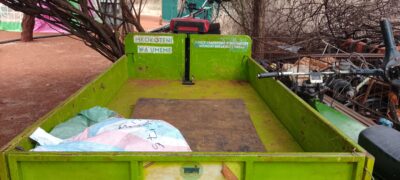
An electric-powered cart (Mkokoteni) used to carry the solar systems to the gardens
Business model
Its starts with service requests by any farmers as long as they are within 2.5 KM radius near a river or water source, field visits are made and then a farmer pays commitment fees that enables transportation of the equipment to their garden. Service delivery is done and irrigation thereafter, the farmer pays after irrigation.
According to Kamau, their short term target is serving 0.8 million Arid and Semi-Arid farmers with in 3Km radius of perennial rivers to irrigate 667,000 hectares of land, middle term target is to reach out to 2.7 million farmers in the Arid and Semi-arid counties of Kenya, potentially irrigating 2.22 million hectares while in the long run, they intend to reach out to 7.5 million farmers national wide, potentially irrigating 3.31 million hectares of land.
They also intend to see that by 2028, there is 30% income increment for farmers, 5000 acres irrigated annually, converting underutilized lands into productive farms, reducing carbon dioxide by replacing diesel irrigation with solar irrigation and meet over USD 5million value of food production to reduce dependency on imports on top of local employment to over 500 people across sun RIDER value chain.
Man irrigating vegetable garden using the sun ridder
Success story
Linda explains their grassroots approach: “We started by implementing the system on our own farm as a demonstration model. When neighboring farmers saw we could produce consistent yields year-round, two of them immediately approached us for services.” That marked the beginning of their success story.
Today, the company operates five mobile solar-powered irrigation systems called Sun Riders — a significant growth from their humble beginnings with just one prototype. They assemble the systems locally. The irrigation systems comprise solar panels, an inverter, a pump, and pipes for drawing water from nearby rivers, an investment they say allows them to support the transition to clean energy.
Has it really worked?
This groundbreaking approach to irrigation has transformed the way local farmers manage their water needs, significantly reducing costs, increasing productivity and transitioning Local Farmers to clean energy. Farmers, share their experiences with this innovative solution.
Stephen Mutua, one of the pioneering beneficiaries who grows maize, says he used to spend Shs 4,500 weekly just on 40 liters of diesel for his two-acre plot, The financial burden that was common among farmers who have at last found relief in the new technology.
One Kathina, a dedicated farmer who has been cultivating organic vegetables for over a decade, expressed her enthusiasm for Linda’s services. “Many never involved themselves in farming because the place is dry and harvests were un- predictable, but with the mobile solar system, we are rest assured of the water and many people have changed their mindset to farming as a business.” she narrated
Before, managing water was a constant struggle. Setting up traditional equipment would require one to be having some good capital on top of worrying about maintenance costs. Since Linda introduced her mobile solar units, everything has changed. People can now focus more on their crops rather than the logistics of irrigation.
It’s no longer a need for people to stay around and operate machines and irrigate the fields like previously, they now pay Linda and her team and save time to do other productive work. It’s a win-win!
James Njiru, another local farmer specializing in large scale kart growing, has also benefited greatly from Linda’s innovation. He says previously, his crop was greatly affected by changing weather patterns and he would sometimes incur great loses but since the induction of the mobile solar system, he has taken advantage and he is now reaping high.
The above farmers represent the many who have embraced Linda’s Mobile Solar Services. Their stories illustrate how innovation in renewable energy can lead to significant improvements in agricultural productivity and sustainability. With the burden of traditional irrigation lifted, farmers in the community are now thriving, thanks to the power of the sun.
Njiru’s Kart plantation being irrigated by the run ridder
Limitations
Like any other business, the sun rider has some limitations. Linda says they are overwhelmed by the demand already with 500 farmers on the waitlist yet they have only five mobile solar equipment system, observing a need to secure more funding to buy more equipment to meet the market demand.
Farmers decried some of their neighbors who don’t use the system denying them a way through to their fields, asking Linda to consider erecting reservoirs and hydrants along strategic points to enable quicker access to water.
To solve the anticipated issues with accessing river Thibu and other water sources, Linda says they intend to construct water sources like bore holes and erect reservoirs in different areas so that in case they can’t access the water source, the business doesn’t get affected.
They can only cover a 3Km radios from the river/water source, meaning they cannot help many people who may be far from the water source, observing a need to buy a more sophiscated equipment that matches any demand regardless of the distance.
Energy sector strategic direction
Kenya’s national energy policy that spells out its strategic direction for the energy sector in the next decade outlines the country’s ambition to generate 100% of its electricity from clean energy sources by 2030 and as of last year, Kenya had 443 MW total installed capacity of solar, making 12.38% of total power generation.
A study by Energy Regulatory Commission (ERC) in 2015, estimated the total megawatts (MW) produced in the solar sector to be over 20 with an expected growth of 15% annually. The Kenya Government’s aim is to have the sector produce 600 MWp by 2030.
A report by Spenomatic Solar Ltd, a Kenyan based company that provides solar energy solutions for homes, businesses, and industries observed that People view solar mini grids as one of the most effective solutions to address the energy access gap in remote regions, where extending the national grid remains impractical or too costly and that as of last year, the solar energy market in the country was projected to grow by 0.79% from 2024 to 2029, resulting into a market volume of 101.40 kilowatt-hours(KWh) in 2029.
The country has a growing installed capacity, government initiatives like Kenya Off-Grid Solar Access Project for Underserved Counties (KOSAP) for rural electrification and a developing solar manufacturing sector with export potential to the East African community while Solar technology is increasingly used not only for basic needs but also for productive economic activities in agriculture and business.
ENDS.