

Bunyangabu Struggles with solar technology for agriculture Due to Lack of technical Experts
By Polite Musa
Miss. Gladys Kahinju, in Garweya village Buhesi sub county Bunyangabu district is stuck with her solar equipment now three months after failing to find a technical expert to help her fix issues with diode.
Kahinju bought her solar equipment in 2019 to enable her produce Irish potatoes and carrots off season, the first solar became faulty in 2022, she bought another in 2023 but it has also failed to work and when she called experts to help her out, they told her it was diode issue but they failed to return back to work on her equipment.
As for her, she doesn’t know what diode does and what exactly is the type of diode she needs to bring back her equipment to life but according to literature, By pass Diodes Prevents the entire panel’s output from dropping drastically and stops shaded cells from overheating and causing damage while Blocking Diodes Prevents batteries from discharging through the solar panels at night or when panels aren’t generating enough power.
The one who had bought solar equipment to enable her produce all year long, Kahinju has now not produced like she expected because her solar diode had issues. She has travelled to Fort Portal over three times to look for experts but she is yet to get one.
Kahinju explaining her struggles with diode
Kahinju isn’t alone, Katungi William, a retired veterinary officer from Rwensenene – Buhesi town council also gotten solar equipment from government of Uganda’s climate smart agriculture/ micro irrigation program but since August last year, his stopper valver that controls water flow to and from the tank has been having issues. His issue may not necessarily be accessing plumbers but the expertize of the plumbers to make quality work.
“I have worked with different plumbers almost every week but the challenge has persisted” He noted. The one who had resorted to solar for irrigation has now suffered a huge loss to the dry spell of July- November and his bananas have not produced like it used to – because water flow to the reservoir tank and to the hydrants is too minimal and sometimes fails to take water to the plantation.
Also, Miss Kengaju Resty from Kakinga town council in Bunyangabu district uses drug horse irrigation to grow vegetables like carrots, green paper, egg plants, potatoes and sprinklers to irrigate her banana planation. Frequent shutdowns during irrigation has destabilized the day to day operation at the gardens and plantation due to a faulty cooling fan but despite trying different people she believes could help her, the issue has persisted. She has now given up on technicians because despite taking a lot of her money every time they come to repair the cooling fan, the issue has persisted and she cannot inject in money anymore.
While Kaijja Moses from Kadindimo Rwimi Sub County says he has had Battery problems leading to reduced capacity and performance. “My batteries became weak to pump water, the pressure of water has drastically reduced”. for him, he has failed to get a proper expert for technical advice, he has since left irrigation to the traditional rain fed farming sighting that solar batteries are expensive, costing over 2.5 million, he is now stuck waiting to get money to buy the new batteries yet the drought season is on, meaning he can no longer produce beans and rice effectively like he used to do before.
Most solar technical issues reported in Bunyangabu; Source- Bunyangabu district production department
Critical shortage of technical experts in rural communities in Bunyangabu has indeed hampered the effective installation, maintenance, and repair of solar energy systems. Despite the growing potential for renewable energy to transform these areas, many solar installations remain underutilized or mismanaged due to a lack of local expertise.
Also, Bunyangabu Agricultural communities that could benefit from solar-powered irrigation are largely economically disadvantaged, often struggle to afford the initial setup and after that struggle, they are unable to maximize the benefits of solar due to technical shortcomings.
Why premature failure.
We asked Mr. Moses Walugembe, an energy policy expert ALE energy – Uganda why solar equipment that is designed to last over ten or even twenty years can be damaged in that shorter period, he blames it on consumers who only buy solar equipment without technical guidance on which capacity can do which job, ending up miss balancing the panel – battery issues.
“You want to buy solar equipment for irrigation? Seek guidance from experts first. Overloading solar reduces the battery life and eventually makes the equipment unable to perform.” noted Walugembe. According to him, even Lower-quality solar products that are preferred by most of the low income farmers may not meet expected durability standards, leading to premature failure.
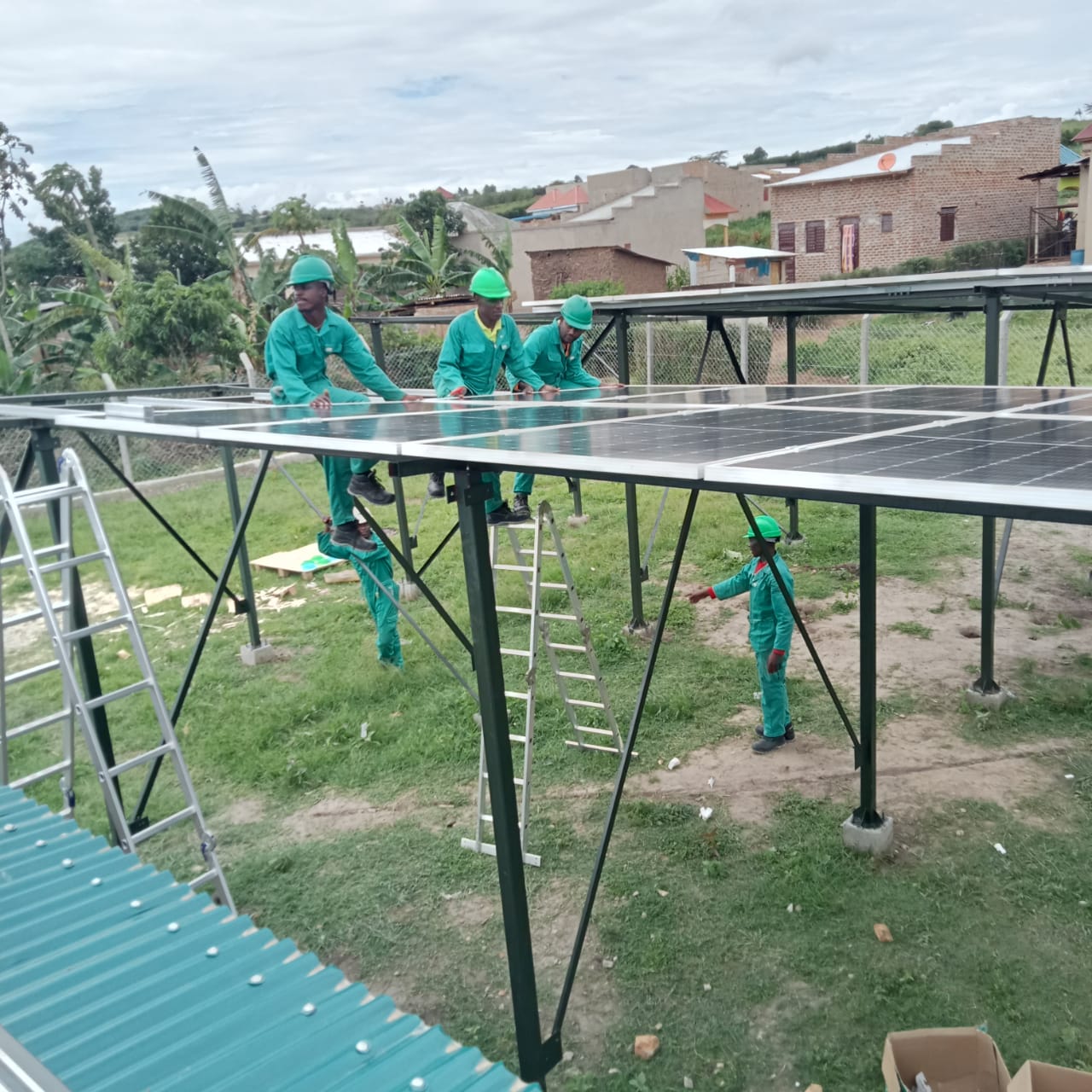
Walugembe insists that even high-quality equipment can fail if installed incorrectly. Common errors include Poor wiring, Unstable mounts, incorrect panel angle, Lack of proper ventilation among others
Common errors related to solar installation and maintenance
Rural area struggles
As of today, most solar technicians prefer living in urban areas due to significant professional and personal challenges inherent to village life. The primary reasons can include but not limited to; Infrastructure & connectivity because urban offers reliable internet, better & cheap transport and stable power, unlike many rural areas.
Vincent Ahimbisibwe, a solar technician at FRES – UGANDA LTD explains some of the other reasons. Career Growth: Cities concentrate more solar projects—both residential and commercial—offering more diverse work, training and advanced opportunities for the skilled technicians. Also, there is Easier access to specialized parts in case of replacements, tools (mostly power tools) and support services in urban hubs—which can never be found in villages while Remote sites, bad roads and lack of local support make repairs harder and slower in villages.
“While some village projects might pay well, consistent high demand for the skilled labor is still very low. More to that, the people in the villages see asking them for a moderate/higher pay for the work done as stealing directly from their pockets because you are elite in that particular field.” he added.
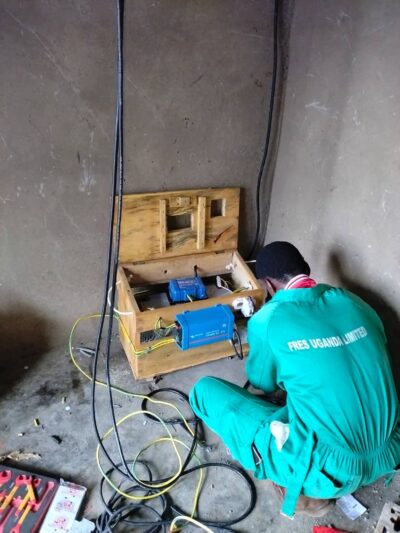
Ahimbisibwe repairing a solar system at one of the sites
Solving the situation?
Ahimbisibwe, says Solar systems should be regularly maintained to ensure maximum performance. Visual checks every few months, cleaning panels 1-3 times a year and a professional inspection/services at least once in 2 years, checking cables and connections, maintaining batteries and inverters.
“We are mainly called for break-down maintenance, when components become faulty or a solar system becomes weak, it is rare for farmers to call us until the systems goes to total fail.” noted Ahimbisibwe.
He suggests other ways like Training & empowering local technicians within the rural communities themselves by Establishing local technical training programs, Utilizing a “train-the-trainer” model—where a trained professional can train a core group of local individuals who then train others within the community, cascading the knowledge sustainably and offering incentives to companies and individuals that repair solar systems deep in the villages to motivate them.
Leveraging technology for support can bridge the geographic gap between urban expert tech and rural systems. This can include installing remote monitoring systems on the solar systems, Mobile learning platforms where technicians in the villages are provided with access to mobile apps or online platforms that can offer continuous learning modules and immediate support from the senior technicians.
Community owned solar projects through Formation of local energy cooperatives that collectively own & manage solar systems, taking responsibility for maintenance and troubleshooting as a community may reduce the cost burden on individuals.
Governance and policy.
Miss. Asiimwe Yusta, The Bunyangabu district production officer says they do follow-up on a monthly basis for the farmers that received the micro irrigation projects and routine visits to wealthy individuals who set up their private solar system to guide them. Apart from the agriculture engineer helping them on simple and minor repairs on a free cost, the district do referrals and link the farmers to technical experts for help. She however acknowledges many may not afford quick help as they may not be having money to pay the experts frequently.
To help on identifying solar related issues, the district production department has established an online platform comprising of all beneficiaries of micro irrigation and a few members that have established solar individually on their farms, this saves farmers from travelling long distances to the district to report the issues with their solar systems but rather use the provide platform, this has helps coordination to tackle technical gaps quickly.
She however believes there is need to change the TVET curriculum from teaching domestic and commercial solar installation only to cover solar pumps and solar irrigation so as to close the technical gap. “Align technical and vocational education and training (TVET) with industry needs by incorporating solar installation, repair, and maintenance into curricula.” she observed
Bunyangabu district production officer Miss.Yusta Asiimwe
Addressing the technical gap
Mr. Mirembe Edson, principle at a native St. Joseph’s technical institute, blames the technical gap on laxity of people in Toro sub region to take up skilling courses. He gives an example where many students pursuing solar related courses at the institute come from Ankole and Buganda regions, an indication that even when they finish studies, they will repatriate the knowledge to their home areas, leaving a gap.
Mirembe also believes that training institutions must train what is required in the real world of work mostly in the field of solar for agriculture where the technology is changing and advancing compared to what it was ten years back. however not many training institutions can address the technical expertise gap because the training equipment itself is expensive, but as an institution, they have taken back their trainers for refresher courses to be re-tooled to match with the current solar technology.
“The curriculum may not adequately address the real challenges and to address this, we have established a department of tracer study officers who go to the field, identify gaps and real needs so that we as an institution can be informed on what to add on our curriculum” This has been possible because the new TVET law allows training institutions to add content in what they teach provided it is needed in field of work.
“Our students from our collaboration with Uganda martyrs university have gone ahead to design gadgets that can detect errors and automate solar systems. We have also integrated teaching of solar cameras and how they can be installed in the gardens for security of the equipment and the crops themselves. “Noted the principle.
Voice principle explaining
Solving the scarcity of technical expertise in the productive use of solar energy (PUSE) requires a multi-faceted approach that combines education, hands-on training, and industry collaboration to bridge the gap between technical skills and agricultural/commercial needs.
A survey by ACODE, and Heifer International on the uses and impacts of off-grid refrigerators in Kenya, Tanzania and Uganda concludes that many solar energy products, especially for productive use, lack standardization and enforcement, leading to the influx of substandard equipment that undermines trust in solar solutions.
Limited technical capacity within government ministries and businesses to implement solar technologies continues to be a challenge. Capacity limitation has also affected integration of Productive Use of Solar Energy in planning and budgeting which have affected financing and implementation at both national and local government level.
This story was produced with support from African Center For Media Excellence in partnership with Charles Stewart Mott Foundation
Ends