

Harnessing the Sun: Solar Subsidies Transforming Agriculture in the Toro Sub-Region
By Polite Musa
As seasons change and production becomes unpredictable in Toro sub region, many district are trying to find ways how to cope up. Crops are drying up even when planting is done in the days previously known for rains. The rains come at a time when farmers expect sunshine and vice versa. Even when the rain comes, it doesn’t last all season long.
This and other challenges are an indication that climate has changed and weather patterns are no longer predictable like they used to be five to ten years back, forcing many into irrigation as an alternative.
The national irrigation policy 2017 mandates government to support individual progressive farmers and organized farmer groups with feasible irrigated agriculture enterprises with purpose to ensure their progression into model farmers and reference to other farmers. This is consistent with the need for transformation of the 68% subsistence farmers that Government has been concerned about, to improving farm productivity and contributing immensely to household incomes as a driver towards attainment of a middle income status.
The government of Uganda through World Bank funded Uganda intergovernmental Fiscal Transfer Program (UGIFT) support micro irrigation through co-funding with farmers according to their size of land to have solar powered irrigation systems to sustain production throughout the year.
Relatedly, agriculture cluster development project (ACDP) the government funded farmers on identified projects like coffee farming, tea farmers to establish demonstration sites that help them irrigate their crops and they help other people to learn from them
In Kabarole district, the Rwengaju middle scale and Kicuna irrigation schemes in Rwengaju Sub County, Masongola irrigation scheme in Kabende Sub County, demonstration sites like Kimuhonde in Kiko town council, those in Hakibale, Busoro, Kaswa and Nyabuswa among others have helped farmers in the district to cope up with changing weather patterns to produce throughout the year.
Groundnuts being irrigated at Masongola irrigation scheme in Kabende sub county
Turyamubona Lauben Keefa, chairperson Masongola small scale farmers association says the 650 Million Masongola irrigation scheme has really improved production throughout the year.
”The season we started using this irrigation scheme we got over eleven million shillings from two hectares as opposed to between three to four million previously” Keefa observed.
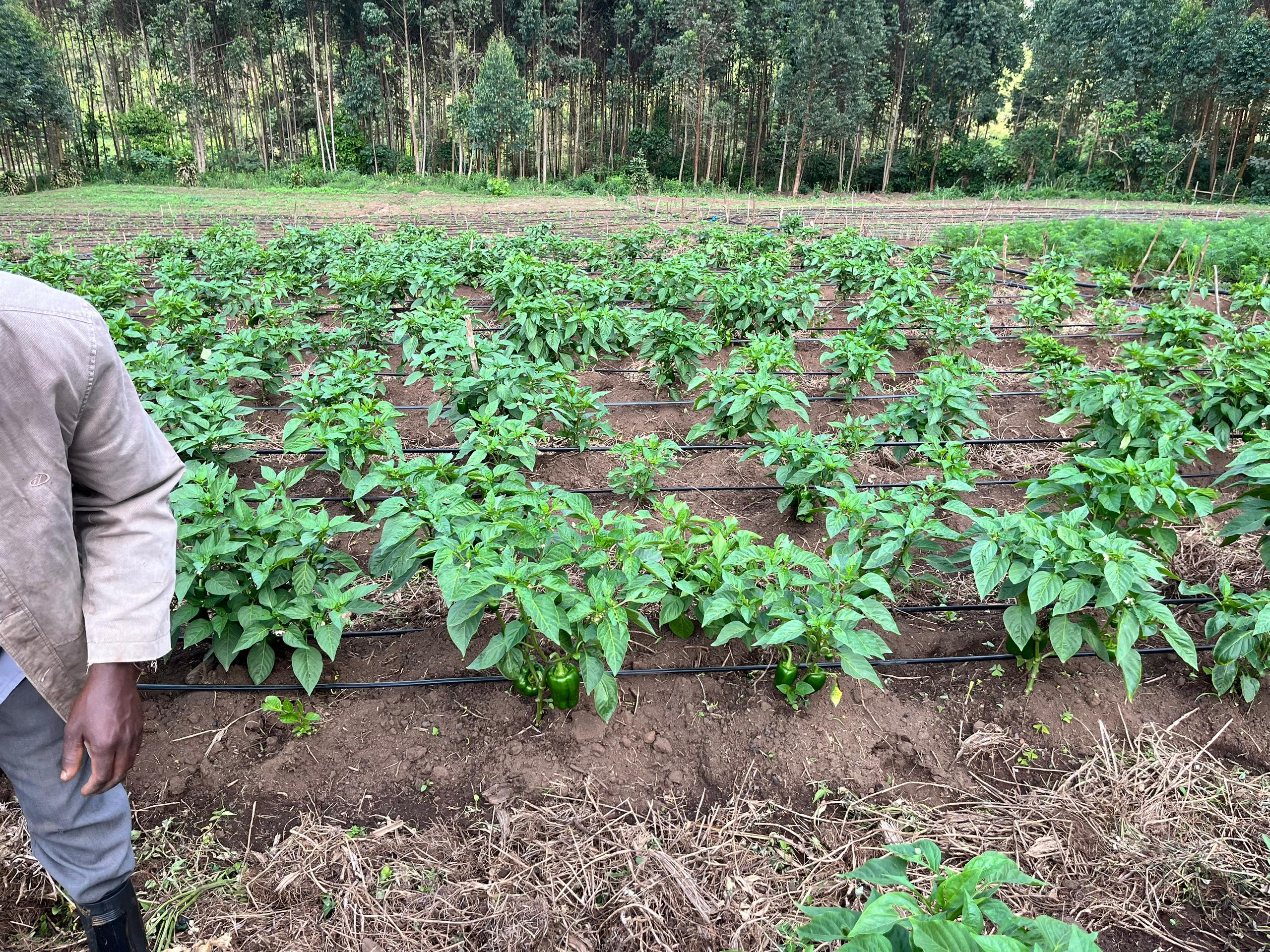
Agaba Abdullah, LC3 chairperson of Rwengaju Sub County says since establishment of Rwengaju middle scale irrigation scheme, over four hundred households that are on the grid have steadily increased production while Mr. Raymond Kalyegira of Kaswa farm produces vegetables all year long with the help of solar irrigation. Drug horse has helped him irrigate carrots, green papers, and egg plants while sprinklers irrigate banana plantation as he produces throughout the year.
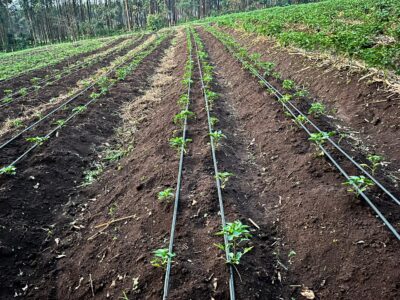 Drip irrigation at Raymond’s gardens of carrots, onions and vegetables
In Ntoroko District, cattle keepers are embracing solar energy and the future looks brighter. The business is becoming more efficient, profitable, and environmentally friendly.
Traditionally, cattle keepers rely on use of generators for water pumping into their farmland pasture and cattle boats/ troughs, and lighting. This dependence on fossil fuels results in High energy costs as expensive and scarce fuel sources eat into already slim profit margins and emission of fossil fuels into the environment while the district’s fragile ecosystem suffered from Overgrazing as unmanaged pastureland leads to soil degradation and reduced fertility.
Kabakama Kedress, a cattle keeper in Rwebishengo sub county says previously she lost close to fifteen cows in two months when the district was hit by drought for close to a year because the animals couldn’t get pasture and all the dams were dry, this has since changed for the last two years after adopting the solar technology to give her animals water and irrigate pastures.
“I save money on fuel, and my milk production has increased by 30% because of pasture sustainability. I no longer have issues of lighting in the calve pens like previously.” noted Kedress
Statistics from the district production office show that Herders lost more than 500 head of cattle following drought in 2019 with the most affected areas are Rwebisengo, Kibuuku, Kanaara and Bweramule sub-counties while in 2021 Ntoroko District lost more than 15,000 cattle due to prolonged drought
Baluku Rojas, the Ntoroko district agriculture engineer says many cattle keepers who have installed solar system on their farms across the district no longer fear harsh weather conditions that would see many cows dying.
Animals drinking on solar powered trough
In Bunyangabu district – Rwensenene village, Buhesi town council, Rwabuhesi George William, a retired veterinary officer is one of the 59 beneficiaries of micro irrigation co- funding. He has managed to produce highbred bananas enabled by the drug horse irrigation. He testifies that before solar establishment, he would produce less that 20 bunches of bananas in one hectare, something that has since changed to one and half trips of bananas because the plantation is healthy with availability of water.
Miss. Kiiza Violet Rubongoya in Kibiito Sub County in Bunyangabu district has diversified into different crops ranging from coffee, cabbages, carrots, green paper, bananas, and tomatoes among others.
“We produce even off season because there is nothing that our solar cannot do for us, even the coffee that I planted has started flowering only one and half years because of constant water supply.” noted Violet
Miss. Asiimwe Yusta, the Bunyanagbu district production officer says throughout the routine monitoring of the beneficiaries of solar subsidies, they have found Miss. Aijuka Patience, a female retired teacher in Rwimi sub county who produces tomatoes all year long and her harvests have increased from around thirty (30) to over ninety (90) per harvest because of constant water supply.
Also, Mr. Isaaya Kalya in Buhesi sub county has drastically increased milk production from around two hundred (200) liters to over five hundred (500) liters monthly because his animals have pastures that are solar powered and no longer suffer drought and water scarcity while Racheal Birungi Ruhweza through the solar irrigation system has seen improvement in coffee production from only four to over ten sacks of coffee per harvest in just a hectare of coffee plantation.
Bunyangabu DPO explaining successes they have reached at
The new technology and associated Challenges
Despite all the advantages, the solar powered systems mostly those that were constructed by government and NGO’s for public have some of the challenges that need to be streamlined.
“we agreed that every (Muhima), a name normally given to herders should contribute five thousand (5000 shs) towards maintenance in case of a break down at the facility but I have registered only mine for the last six months yet cows from around three villages use this well” noted Mary Kamwine, chairperson water user committee at one of the solar powered troughs in Rwebisengo sub county – Ntoroko district
Solar powered systems are Weather Dependent and reliant on sunlight, which can be inconsistent due to weather conditions, this mean that when the water in the reservoir tank is used up and the weather isn’t sunny, there is some inconvenience.
Also, for those that use the drug hourse irrigation, its tiresome because to irrigate a wide coverage, one has to carry the pipe throughout the process whioch is tiresome.
To some farmers like Miss. Violet and others whose pumps were not immersed in the water source, it’s inconveniencing to carry the pump every time they need to irrigate. And also, there are no technical experts to maintain and repair solar systems in the villages, this means putting in a lot of money to invite the technical person whenever there is a breakdown or any technical issue with the system.
Draught report
According to the national irrigation report 2017, In 2010, alone, drought accounted for 38% and 36% loss in production for beans and maize respectively, in 2014, the country registered Uganda shillings 2.8 trillion (8%) loss of Gross Domestic Product (GDP) and 87% loss to agro-industries (Mwaura et al 2014).
In 2011 alone, the Department of Disaster Management of the Office of the Prime Minister estimated the damage and production losses as a result of climate change at UGX 4.3 Trillion which translates to about 7.5% of GDP.
Ends